The challenge: outdated processes make transformation hard
Picture this: you���ve raised a new round, rolled out a highly tailored CRM, and scaled headcount from 15 to 150. A year later, usage is sporadic, data hygiene is shaky, and leaders still don���t trust the numbers. The problem usually isn���t the platform, it���s the operating model around it.
Modern revenue teams don���t need another portal. They need answers in the flow of work, content that stays accurate by design, and enablement that connects directly to outcomes like stage progression, win rates, and time to close. If finding the ���one right thing��� takes more than 30 seconds, reps disengage and ROI stalls.
The stakes: more than what meets the eye
On paper, the stakes are licenses, admin hours, and the sunk cost of rollout. In reality, the stakes are pipeline confidence, seller productivity, and the trust your field has in the systems they���re asked to use.
When guidance is scattered or stale, reps revert to tribal knowledge, managers spend meetings re-teaching basics, and deals slow down. Conversely, when your platform delivers trustworthy guidance at the exact moment of need, you get cleaner data, faster cycles, and a repeatable path to revenue.
The shift: from portals to performance
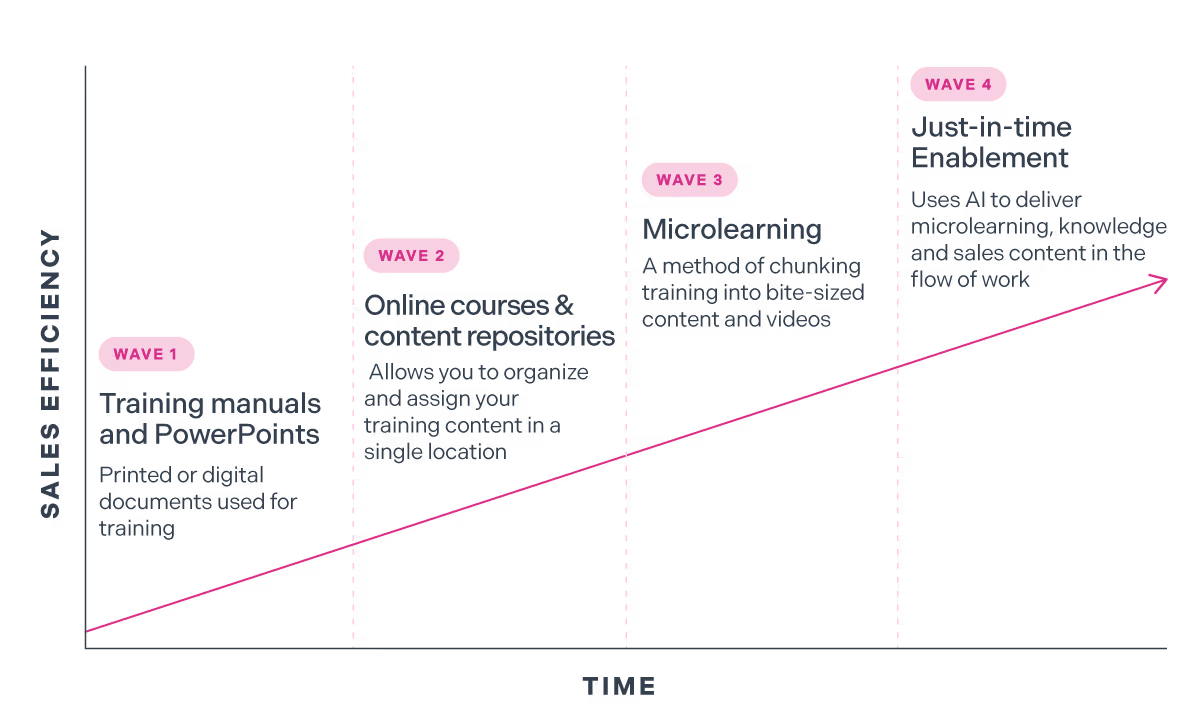
Enablement has changed in three durable ways:
- From destination to in-flow. Guidance appears inside CRM, email, chat, and call tools, no tab-switching or hunting.
- From static to dynamic. AI helps detect decay, flag duplicates, and propose updates so content remains trusted.
- From usage to outcomes. Leaders measure impact on pipeline movement, win rates, ramp, and time to close, not just logins.
This is the core idea behind my book, Just-in-Time: Enablement in a World of AI: fewer, better answers ��� delivered precisely when the rep needs them.
The solution: learning and doing, at the same time
Training that lives outside the work rarely sticks. The winning model embeds bite-sized guidance where work happens and reinforces it continuously:
- Field-level help beside required CRM steps.
- AI-authored snippets that summarize the ���why we win,��� talk tracks, and proof.
- Change alerts that target only the impacted teams at the moment of need.
- Deal Rooms/buyer hubs that package the right assets in one link and track engagement to inform next steps.
The result is a loop: reps act ��� the system observes ��� AI recommends ��� managers reinforce ��� leaders see impact.
A pragmatic path: how top teams enable platforms
- Map friction: Identify three moments that slow deals (pricing, security, stage hygiene).
- Publish micro-content: One page each: ���why we win,��� top objections with proof, and the next best action.
- Deliver in-flow: Surface the single best snippet in under 30 seconds across Salesforce, Gmail/Outlook, Slack, and call tools.
- Govern by design: Owners, freshness SLAs, duplicate detection, version control.
- Measure outcomes: Tie usage and buyer engagement to stage progression, velocity, and win rate.
- Iterate weekly: Replace low performers, promote high-impact assets, and close gaps surfaced by searches and calls.
How 窪蹋勛圖厙 is different (and why it matters)
Traditional content hubs store files. 窪蹋勛圖厙 operates as an intelligent enablement layer that unifies content management, AI-powered authoring, and in-flow delivery:
- AI Sidekick recommends the one best asset or talk track based on context (record type, stage, email thread, call transcript).
- Governance dashboards keep content accurate with freshness checks, ownership, and dedupe, so reps trust what they find.
- Change enablement targets updates precisely, so teams learn as they work, not in a separate portal.
- Deal Rooms share curated, always-current content in one link and capture buyer engagement tied back to pipeline.
- Revenue insights connect content and actions to business impact, so you evaluate platforms on outcomes, not feature lists.
The evaluation lens: choose for outcomes, not ornaments
If you���re weighing options, anchor on three questions:
- Time-to-answer: Can a rep find and send the right thing in under 30 seconds, in their current tool?
- Governance: Does the system keep content accurate by design (owners, freshness, dedupe) without spreadsheets?
- Measurement: Can you tie usage and buyer engagement to stage movement, velocity, and win rate without manual stitching?
Build a simple evaluation grid with your top three problems, the must-have capabilities to validate in a pilot, and objective criteria like ease of use, integration lift, and total cost of ownership. Your frontline sellers and their managers are the most important voices in that process.
Bottom line
Platform investments pay off when guidance is trusted, instant, and actionable.
Move from portals to performance: unify your content layer, deliver just-in-time with AI, govern it by design, and measure impact on revenue.
That���s how you turn your sales platform into a force multiplier ��� one that sellers love, managers reinforce, and leaders can confidently scale.